
Every day, your child's home screen shows today's lesson and a big Start button. The teacher leads it: eight kinds of short steps, from a warm-up to a book, with the teacher saying what to do in each one. A miss never shows red or an X, the help comes in steps, and the lesson ends with “All done today!” and a button back home.
- 8 kinds of steps
- 3 age bands
- The teacher's voice
- Never called a test
The eight kinds of steps
The titles are the ones on the screen. These are the eight kinds of steps; on the screen a lesson shows up to 11, because the quick game and a short practice of the new sound are steps of their own. Steps marked “from age 5” are left out for ages 3 to 4, whose lesson comes in small blocks with a “Great job!” break between them.
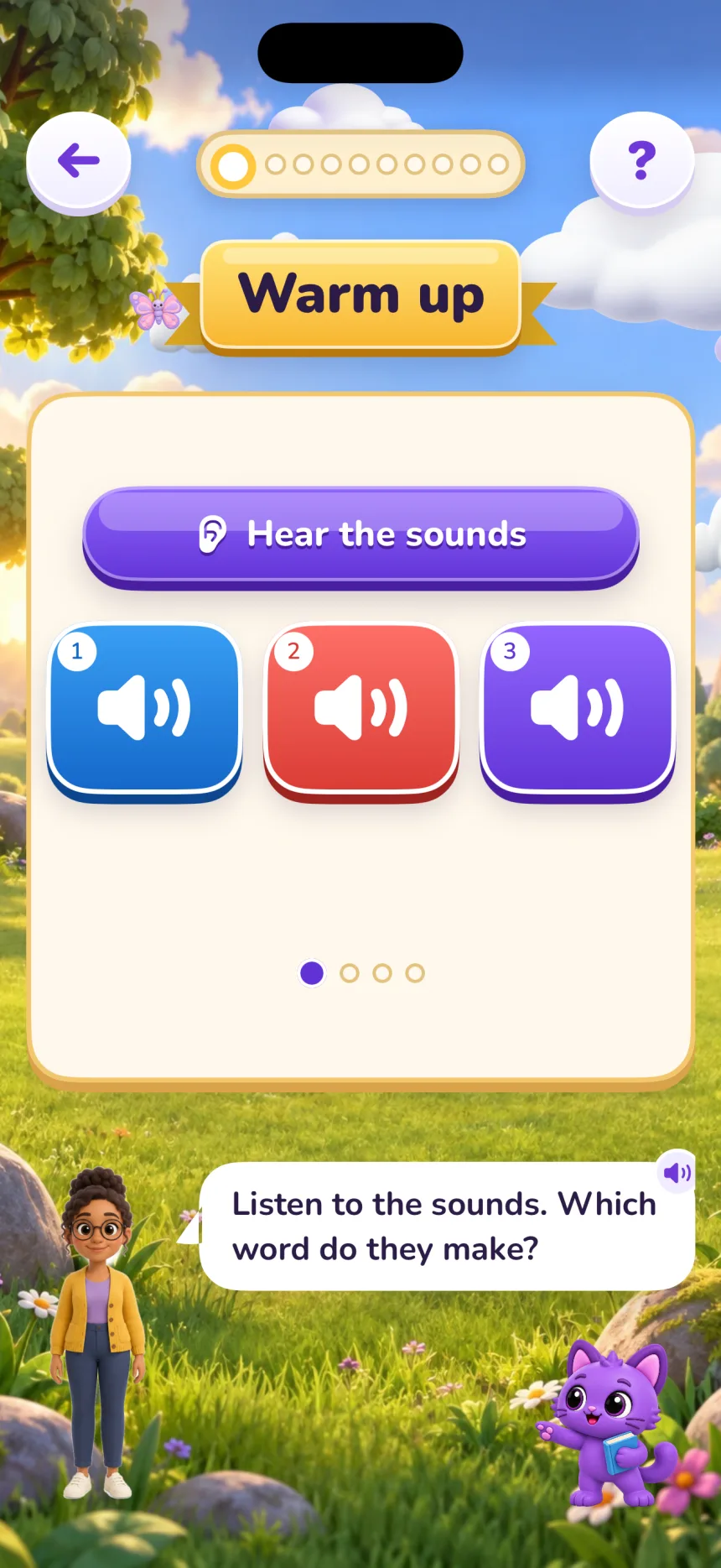
- 1Warm up“Listen to the sounds. Which word do they make?” The teacher says a few sounds and your child picks the word they make, out of three.
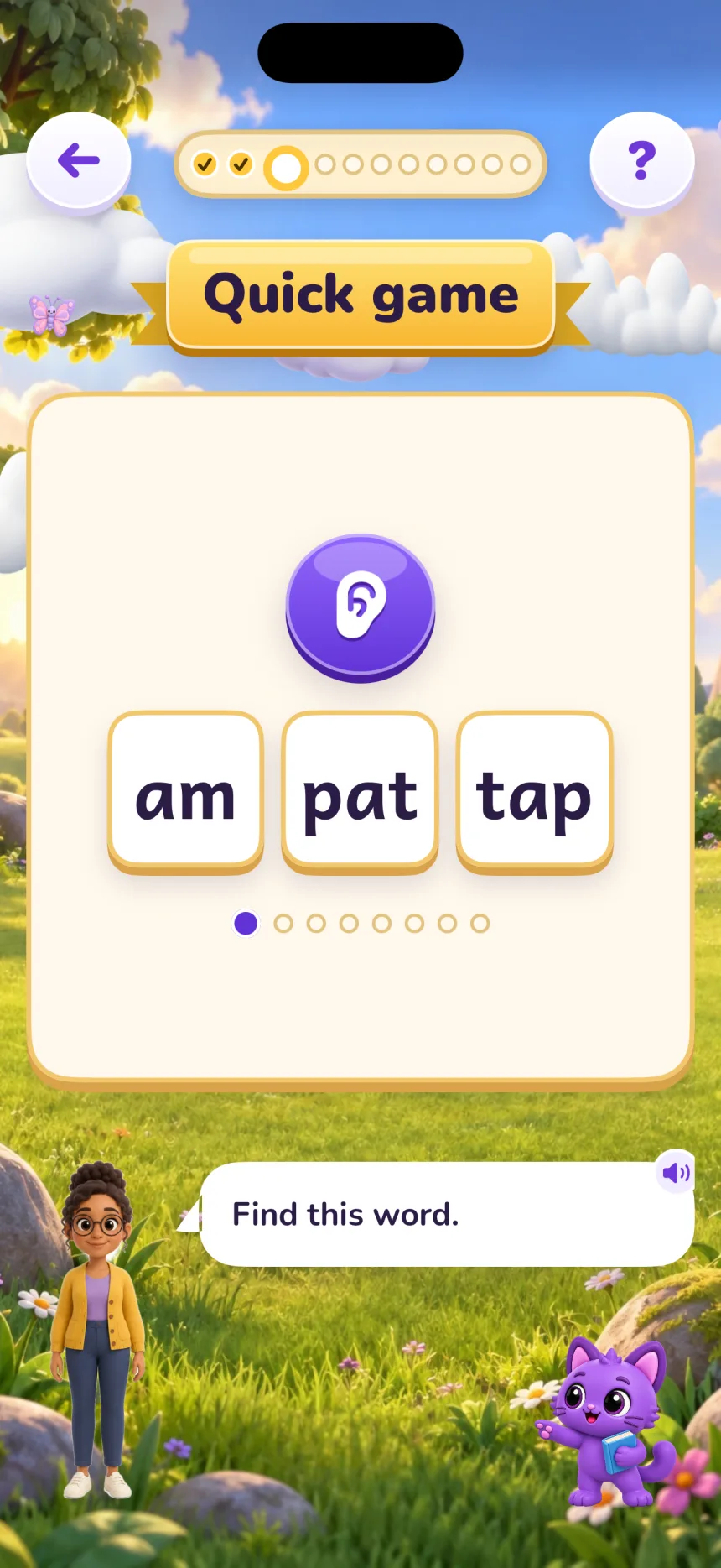
- 2Hear it, find it“Listen. Which letter makes this sound?” Hear a sound, or a letter's name, and tap the letter. In almost every lesson, a short quick game is built into this step, and it is never called a test.
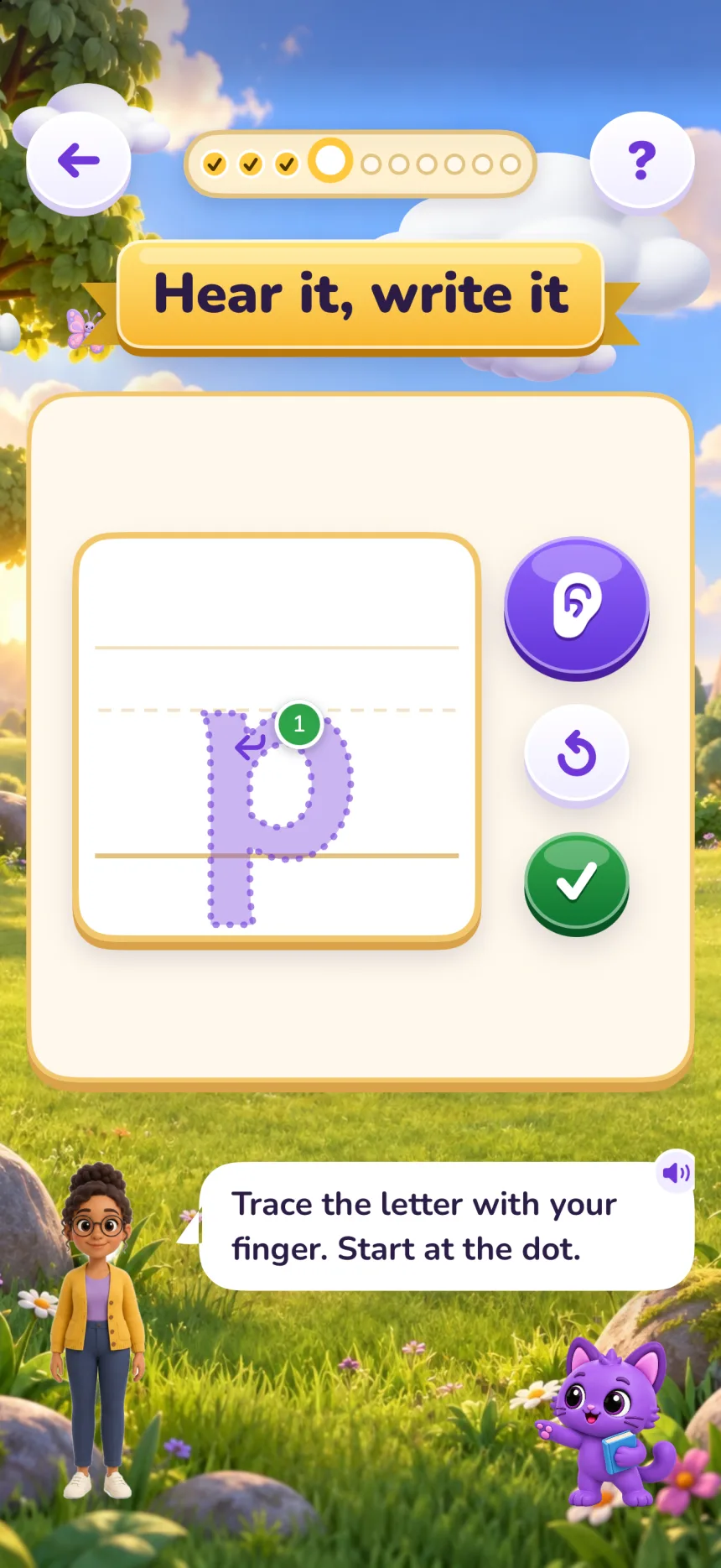
- 3Hear it, write it“Trace the letter with your finger. Start at the dot.” Trace the letter with a finger. If it doesn't pass: “Let's trace it once more. Start at the green dot.” The second try always moves on, with no grade.
- 4Blend (from age 5)“Slide your finger under the word. Then read it to me.” The sound slider: each sound is said as the ball passes, then the whole word. Then your child reads it, aloud if listening is on.
- 5New sound“Here is today's new sound.” Today's new sound, as a big letter tile. The first sounds come with their mascot: “Meet” plays its greeting and “Watch” opens its clip. Right after, a quick practice of the new sound.
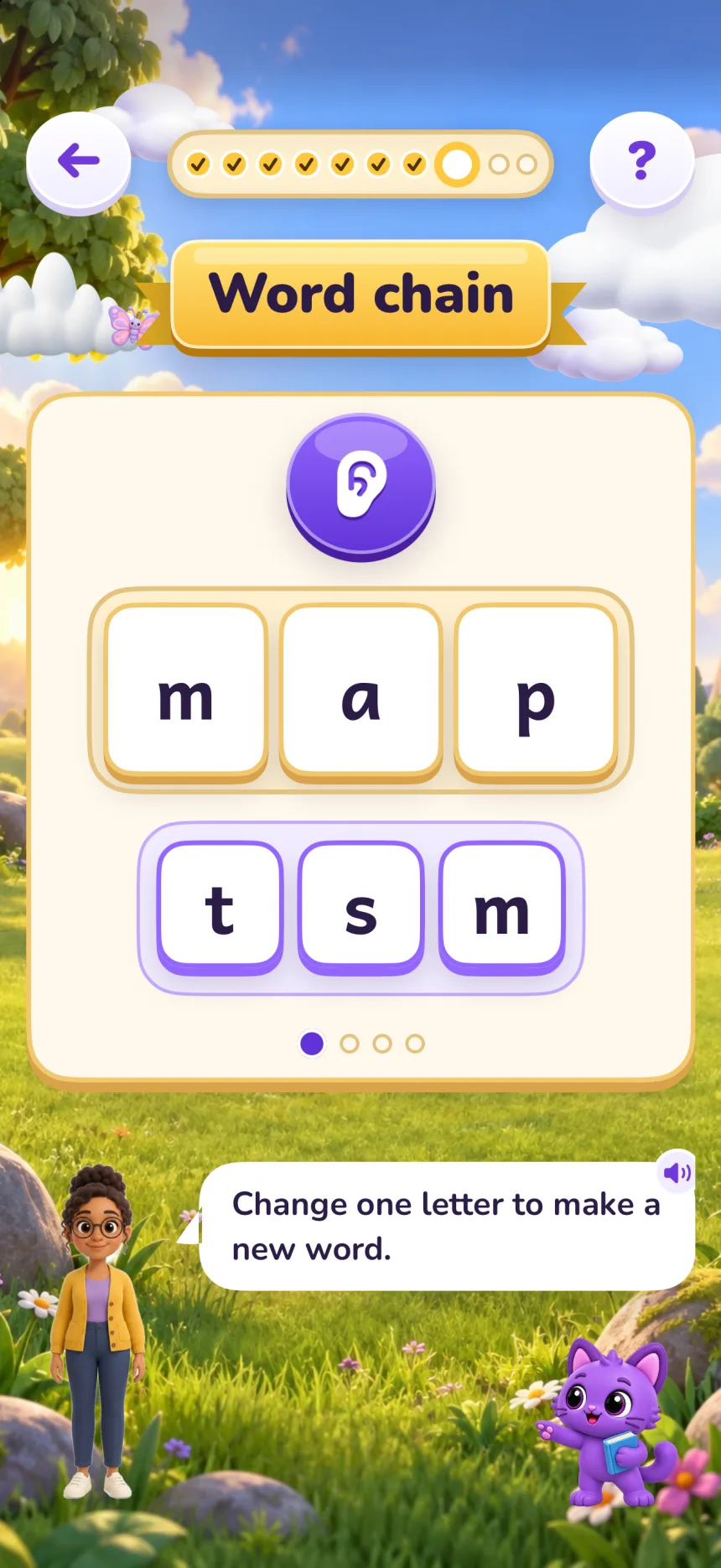
- 6Word chain (from age 5)“Change one letter to make a new word.” Change one letter to make the word the teacher asks for: sat → mat → map.
- 7Heart word“This is a heart word. The heart part is tricky, so we learn it by heart.” A heart above the tricky part, a line under the regular letters, and the word built with letter tiles.
- 8Listen and build, then Story time“Listen to the word. Then build it with the letters.” Build a word the teacher says (from age 5), then the lesson's book (“Let's read a book!”), or, in lessons without a book, the Sound game: “Listen to the sound. Which friend starts with it?”
When your child gets one wrong
The piece shakes a little, never red and never an X. After two misses, the right answer lights up. After three items in a row are missed, the next ones come with only two choices. The “?” button offers “Watch me first. Then you try.”, and the answer is shown. Answers given with help don't count toward mastery: only answers right without help do.
Moving on, and coming back
- A sound counts as mastered after four right answers in the last five, without help.
- Mastered sounds come back for review after 1, 3, 7, 14 and 30 days.
- A lesson moves on when its new sound is mostly right (60%), or after 3 sessions. As the app puts it: “A new sound moves on once it is mostly right, or after 3 sessions, and it comes back later for review. No one gets stuck.”
- Almost every lesson has a quick check inside a game (letter names, letter sounds, first sounds or words). It is never called a test. After at least six quick checks, if the last four went well, your reader moves ahead; if the last four were hard, the lessons give extra practice and you get a note in Grown-ups.
- Reading aloud never decides progress on its own: tapping and building words do, and so does your “Got it” on the letter cards of a session together.
Where your child starts
A grown-up adds each reader with a few questions: name and picture, age, whether your child knows the letters, whether your child can read words, and whether the app may listen. From the answers, the app suggests a starting lesson. You can also play the reading game, which suggests where to start and can be played again any time. The child sees a balloon rising on a rope as they answer, never right or wrong, never a score.
A clear finish
When today's lesson is done, the home screen says “Daily done!”. There are no streaks: nothing is lost on a day without a lesson. In Grown-ups you can set lessons per day (no limit, 1, 2 or 3); after the limit, the home screen says “See you tomorrow! You can read your books.”
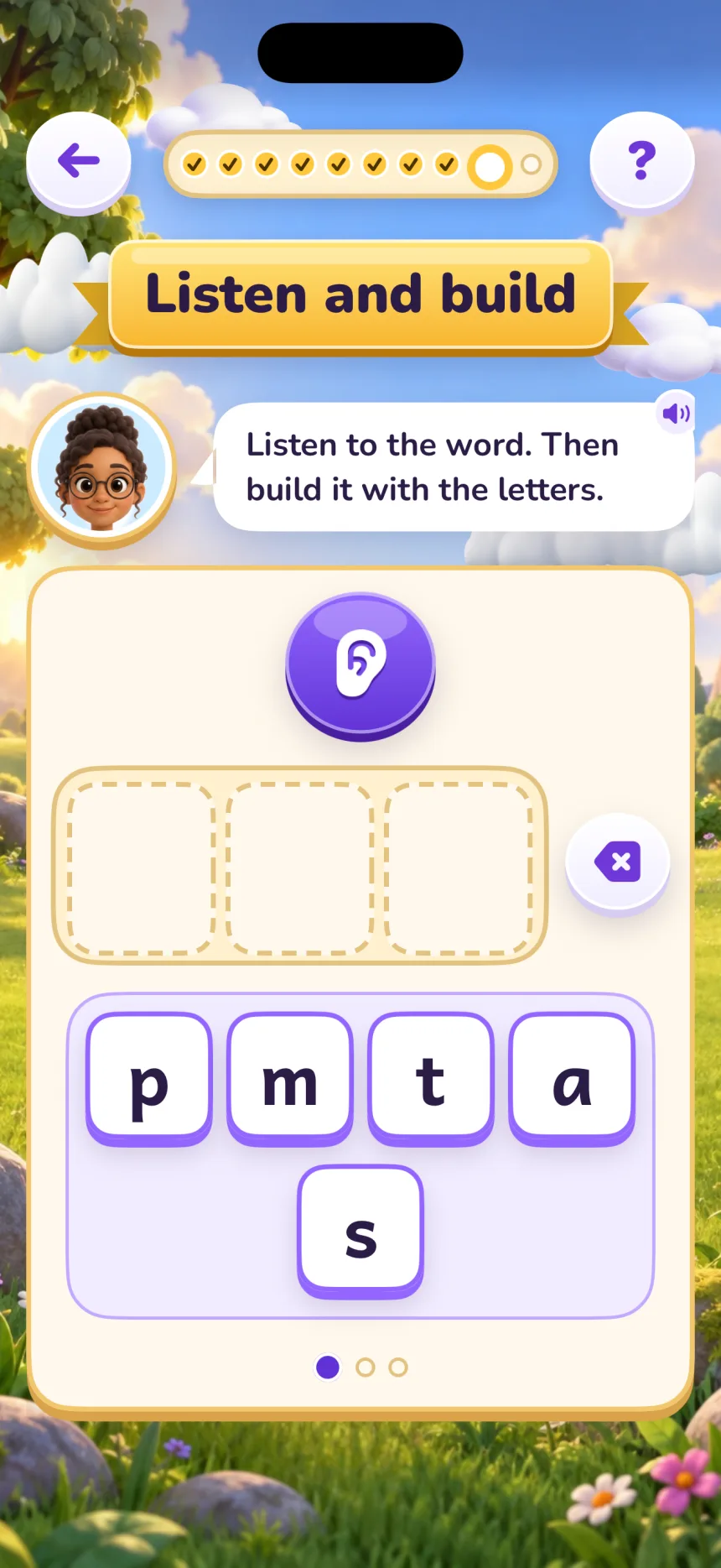
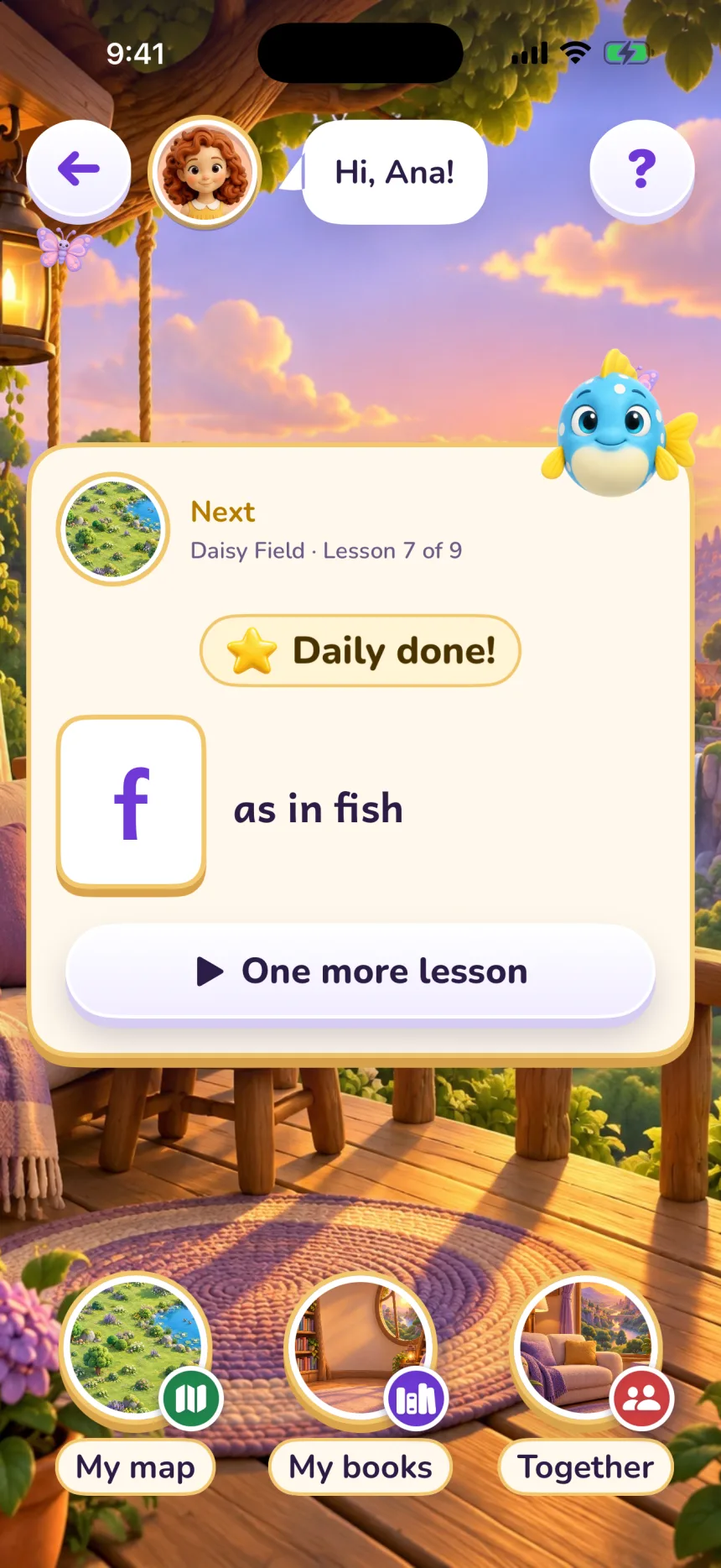
Real screens from the app, in the iPhone simulator, with a test reader.
Questions
How long is a Zupzi Read lesson?
Short: eight kinds of steps, fewer for ages 3 to 4, whose lessons come in small blocks with a break between them. You can stop in the middle; “Continue” picks up the same lesson.
Does my child need to read the instructions?
No. The teacher says what to do in each step, and each sound, letter name and word in the lessons.
Is there a test?
Almost every lesson has a quick check inside a game, and it is never called a test. The lesson always ends the same way, with “All done today!”; grown-ups see the quick checks in Grown-ups › Progress.
What happens if my child finds a lesson too hard?
The help comes in steps (the right answer lights up after two misses, two choices after three), the lesson can repeat, and after three sessions it moves on with the sound coming back in review. You can also move your reader one lesson easier with one tap.
More about Zupzi Read
- Scope and sequence
- How a lesson works
- Decodable books
- An app that listens
- With a grown-up
- Wi-Fi, ads and purchases
- The method, with sources
Or follow the path, topic by topic: